

Introduction
In this blog we will process the inbound process in our warehouse while purchasing a container of Corona Extra beer. We will follow the steps in Business Central according the Advanced Warehouse setup as described in our setup blog post.
Setup
This scenario is using the Warehouse Setup with Avanced Warehousing, the most extensive option in Business Central.
Used item in this scenario is Conona Extra bottle 330ml with itemNo. 1000.
For this scenario the most important fields are the Unit of Measure settings.

Unit of Measure settings

Since the UOM’s Pallet and 40’FCL have Volume (Cubage) measurements, the system will calculate the volume based on the available space as set in the Bin setup.
Important fields on the Item Card.
| Field | Value | Comment |
| Base Unit of Measure | Bottle | The UOM in which the item is in stock |
| Purchase Unit of Measure | Pallet | Standard UOM on Purchasing |
| Put-away Unit of Measure Code | Pallet | When receiving, the quantity will be calculated and received in Pallets |
Inbound Warehouse Process
The following diagram illustrates the inbound warehouse flow by document type in advanced warehouse configurations. The numbers in the diagram correspond with the steps in the sections following the diagram.

Creating a Purchase Order
The first step is to create a purchase order. Officially this step is not part of the inbound Warehouse Process, but for the scenario this input is needed. Therefore it is shown here.
There is one Purchase Line on this order, where we purchase one 40′ container FCL. This container has (as seen in the Item Unit of Measure setup) 22 pallets on it, containing 84 cartons each, with 24 bottles in each carton.

Release Source Document (1)
When items are received in the warehouse, the user who is responsible for receiving releases the source document, such as a purchase order or an inbound transfer order, to signal to warehouse workers that the received items can be put away in inventory.
Create Inbound Request (2)
When the inbound source document is released, an inbound warehouse request is created automatically. It contains references to the source document type and number and is not visible to the user.
Create Warehouse Receipt (3)
On the Warehouse Receipt page, the user who is responsible for receiving items retrieves the pending source document lines based on the inbound warehouse request. Several source document lines can be combined in one warehouse receipt document.
The user fills in the Qty. to Handle field and selects the receiving zone and bin, if required.
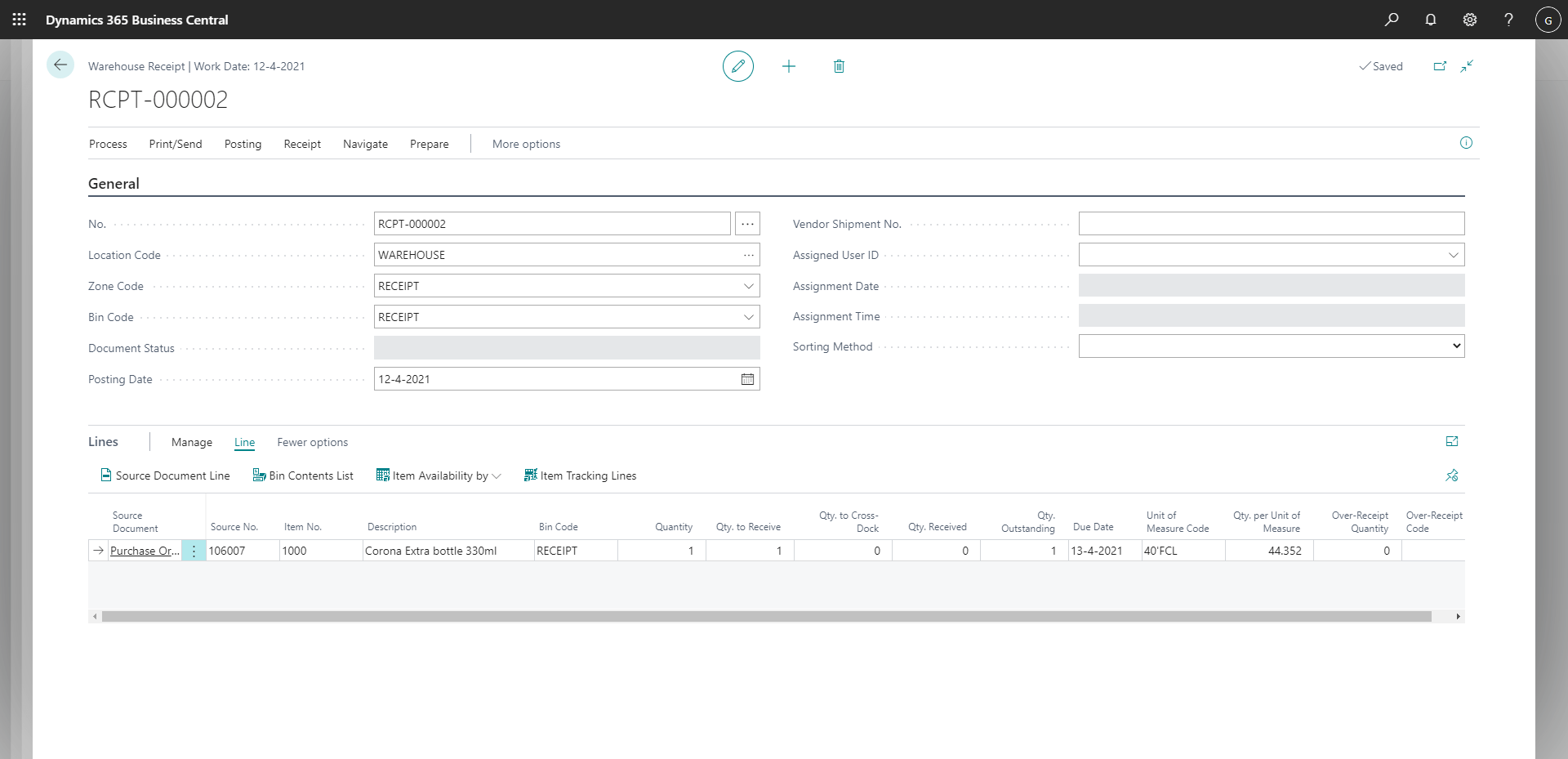
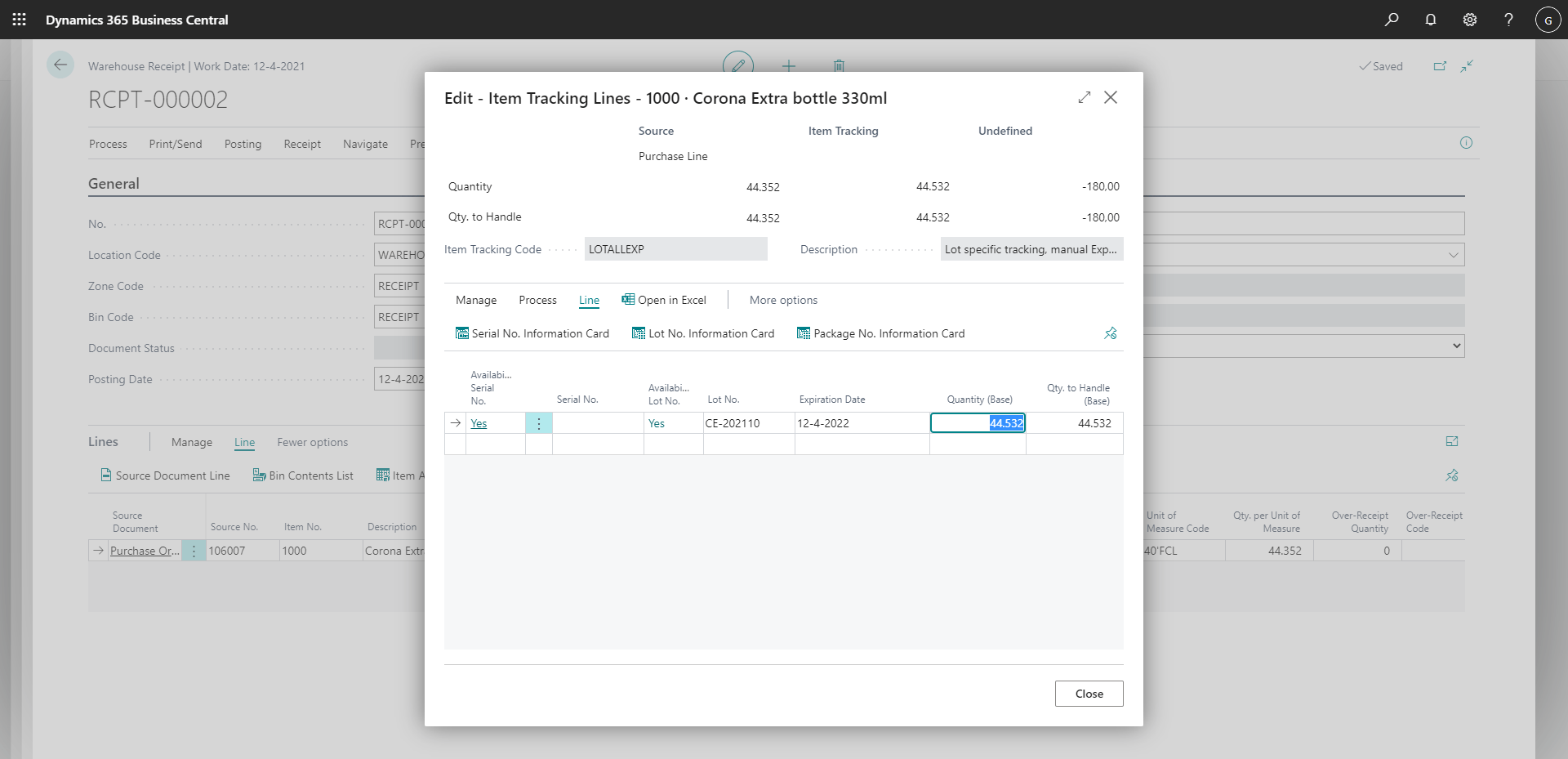
In this scenario, Lot-Tracking is set up. Before posting a Receipt it is needed that the Receipt Lines have Lot numbers added to each line. This can also be done at the Purchase Order (it then transfers the Lot info to the Receipt Lines), but normally this is added during the Receipt process. Preferably by scanning it from a lable on the pallet with a handheld device.
Post Warehouse Receipt (4)
The user posts the warehouse receipt. Positive item ledger entries are created. For example, the Quantity Received field on the inbound source document line is updated.
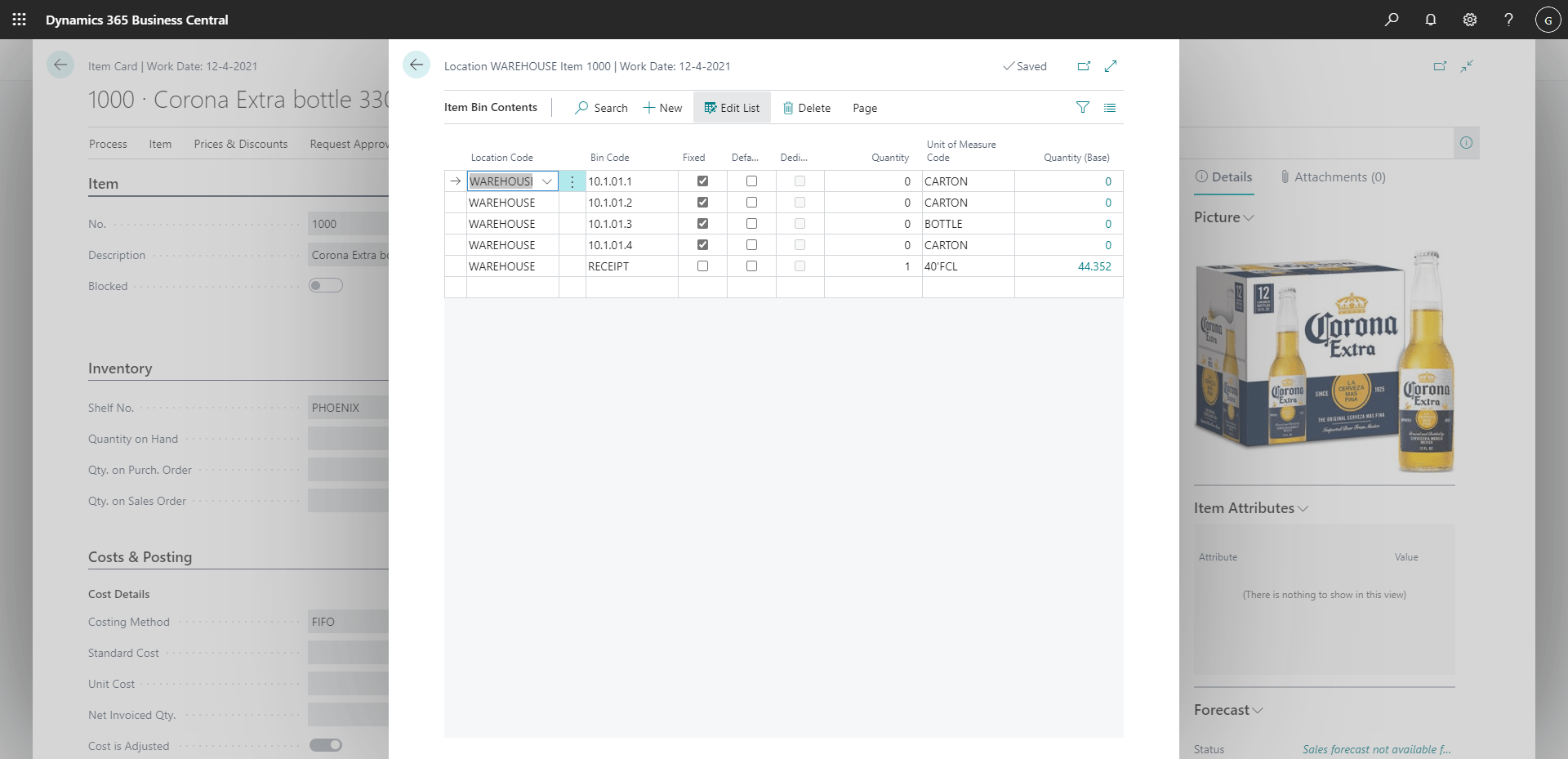

After posting the overview of stock on the Item Card, is changed. The Fixed Bins for this item are always shown, while the stock on the Receipt bin is newsly added.
The Warehouse Dynamics app shows the same result in the Bin Content overview.
Create Warehouse Internal Put-Away (5)
The user who is responsible for putting away from internal operations creates a warehouse internal put-away for items that have to be put away in the warehouse, such as production or assembly output. The user specifies quantity, zone, and bin from where the items should be put away, potentially with the Get Bin Content function. The user releases the warehouse internal put-away, which creates an inbound warehouse request so that the task can be retrieved in warehouse put-away documents or in the put-away worksheet.
Generate Put-away Worksheet Lines (Optional)
The user who is responsible for coordinating put-aways retrieves warehouse put-away lines in the Put-away Worksheet based on posted warehouse receipts or internal operations with output. The user selects the lines to be put-away and prepares the put-aways by specifying which bins to take from, which bins to place in, and how many units to handle. The bins may be predefined by the setup of the warehouse location or operation resource.
When all put-aways are planned and assigned to warehouse workers, the user generates the warehouse put-away documents. Fully assigned put-aways lines are deleted from the Put-away Worksheet.
If the Use Put-away Worksheet field is not selected on the location card, then warehouse put-away documents are created directly based on posted warehouse receipts. In that case, step 7 is omitted.
Create (8)
The warehouse worker who performs put-aways creates a warehouse put-away document in a pull fashion, based on the posted warehouse receipt. Alternatively, the warehouse put-away document is created and assigned to a warehouse worker in a push fashion.

Put Away (9)
On each line for items that have been put away, partially or fully, the warehouse worker fills in the Quantity field on the Warehouse Put-away page, and then registers the warehouse put-away.
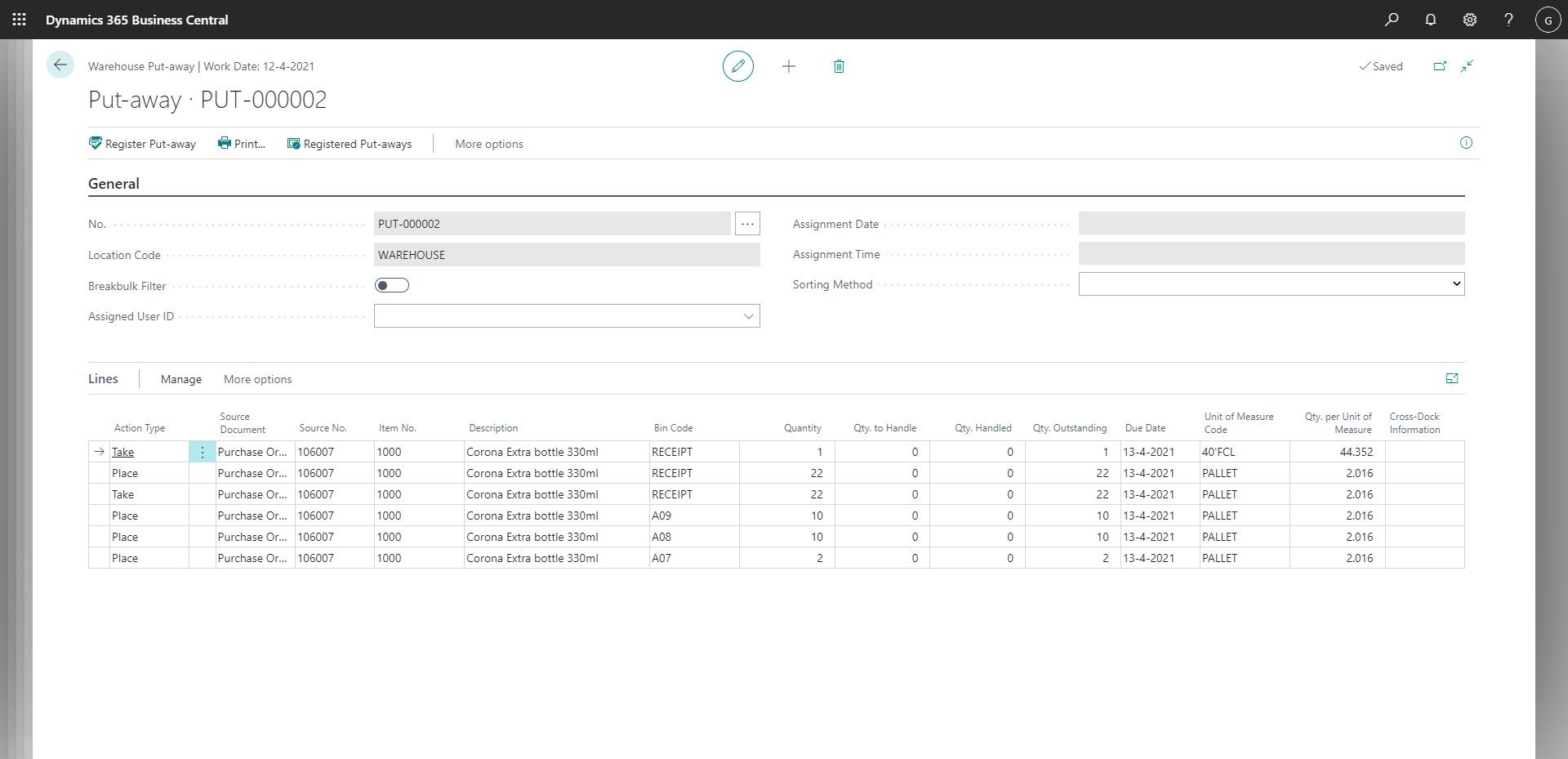
Explanation of lines
| Take | Take the contents of the container from the Receipt location |
| Place | and create 22 pallets from it, put those 22 pallets in the receipt bin |
| Take | Take 22 pallets from the receipt bin |
| Place | Place 10 pallets into (free) bin A09 (A09 comes before A08 due nummeric value with the same priority; 10 pallets max due the max available volume in this bin) |
| Place | Place the next 10 pallets into (free) bin A08 |
| Place | Place the last 2 pallets into the next bin, A07 |

When using the option for the Breakbulk Filter, the shown lines are slightly different. Only the resulting lines – the relevant lines, so to say for the Warehouse Employee are shown. The rest gets filtered. I would opt to have this as standard enabled.
Warehouse entries are created, and the warehouse put-away lines are deleted, if fully handled. The warehouse put-away document remains open until the full quantity of the related posted warehouse receipt is registered. The Qty. Put Away field on the warehouse receipt order lines is updated.
Result on location stock after posting the Warehouse Put-Away document.

The 22 pallets are stored in the bins A07, A08 and A09. Those 4.032 bottles on the Receipt bin are from the Order/Receipt from the Warehouse: inbound process purchasing two pallets of bottles Corona Extra beer blog-post.
Sources
This scenario is created with a SaaS Business Central environment. Some texts are used from the Microsoft Docs knowledge base (see link below), and enriched to give the optimal experience for the scenario.




Leave a Reply
Your email is safe with us.